
What Is Menu Engineering?
Every restaurant owner wants a menu that attracts customers, drives sales, and generates strong profit margins. But knowing which menu items are actually contributing to your bottom line isn’t always easy.
That’s where restaurant menu engineering comes in.
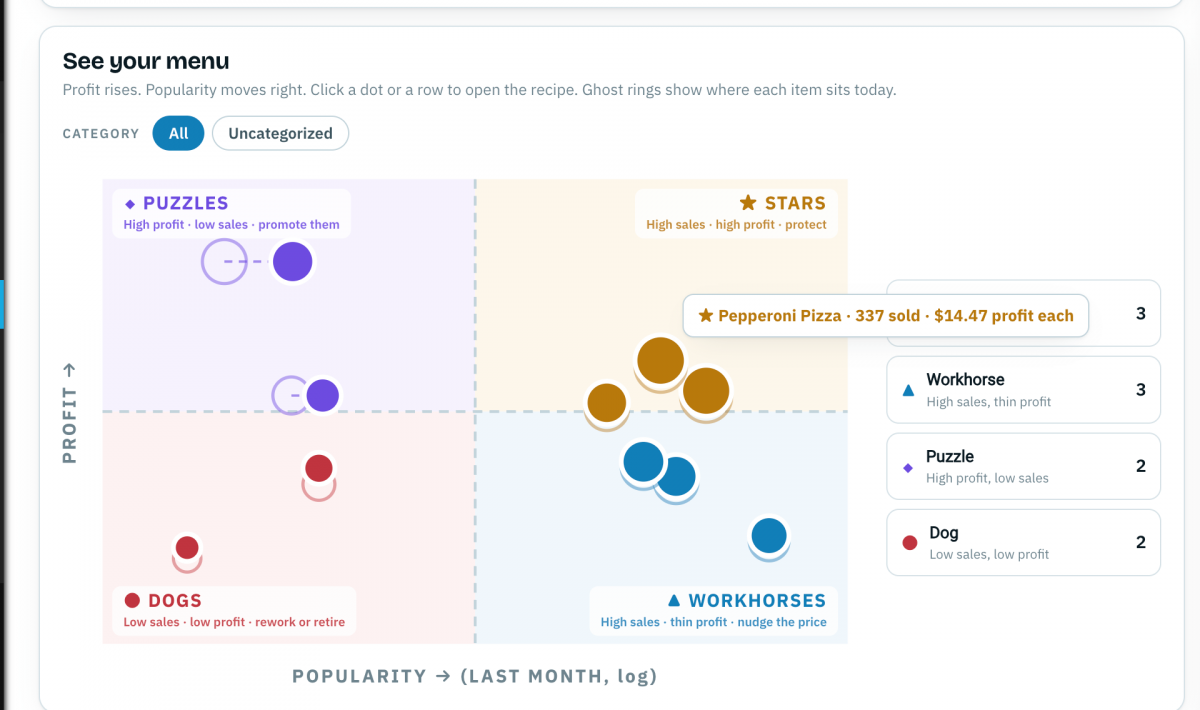
Menu engineering is the process of evaluating menu items based on two important factors: popularity and profitability. By analyzing how frequently a dish sells alongside how much profit it generates, restaurant operators can make more informed decisions about which items to promote, reprice, improve, or remove.
Rather than relying on intuition or simply looking at best-selling items, menu engineering uses actual sales and food cost data to reveal what’s really happening on your menu.
Why Is Menu Engineering Important for Restaurants?
A dish can be incredibly popular without being particularly profitable. Likewise, a highly profitable dish may be overlooked simply because it doesn’t sell as frequently.
Without understanding both factors, restaurants risk making menu decisions that negatively affect their margins.
Effective menu engineering helps restaurant operators:
- Identify profitable menu items: Understand which dishes contribute the most profit.
- Recognize underperforming items: Identify dishes that sell infrequently or generate limited profit.
- Make smarter pricing decisions: Find opportunities to adjust menu prices based on food costs and profitability.
- Optimize menu offerings: Determine which dishes deserve more attention and which may need to be reconsidered.
- Improve promotional strategies: Focus marketing and promotions on items that support business goals.
- Protect profit margins: Make decisions based on actual costs and sales rather than assumptions.
Ultimately, menu engineering helps restaurants understand not just what customers are ordering, but how those purchasing decisions affect the business.
The Two Key Factors in Menu Engineering
Menu engineering evaluates every menu item using two primary measurements.
1. Menu Item Popularity
Popularity measures how frequently a particular dish sells compared to other items on the menu.
Your best-selling items may attract customers and generate substantial revenue. However, popularity alone doesn’t tell you whether those items are making you money.
2. Menu Item Profitability
Profitability looks at how much profit a menu item generates after accounting for its food cost.
A dish with a relatively high selling price isn’t necessarily highly profitable. Ingredient costs, portion sizes, and other factors can significantly affect its contribution to your bottom line.
By evaluating popularity and profitability together, restaurants can identify opportunities that might otherwise go unnoticed.
How to Use Menu Engineering to Improve Restaurant Profitability
Once you understand how your menu items perform, you can use that information to guide your decisions.
Promote Your Most Profitable Items
Identify dishes that generate strong profits and consider giving them more visibility through menu placement, server recommendations, and promotions.
Reprice Items When Necessary
If a popular dish isn’t generating the profit you expect, review its ingredient costs, portion sizes, and selling price. Adjustments may help improve profitability without necessarily removing a customer favorite.
Reevaluate Underperforming Dishes
Menu items that sell infrequently and generate limited profit may be candidates for improvement or removal. Consider customer preferences, preparation requirements, and overall menu strategy before making changes.
Review Your Menu Regularly
Food costs and customer purchasing patterns change. Ingredient prices fluctuate, customer preferences evolve, and some dishes perform differently throughout the year.
Regularly reviewing sales and food cost data helps restaurants make adjustments based on current business conditions rather than outdated assumptions.
Why Accurate Food Cost and Sales Data Matter
Menu engineering is only as useful as the information behind it.
If food costs are outdated or sales information is incomplete, profitability calculations may not accurately reflect how menu items are performing.
Restaurants need reliable information about:
- Ingredient and recipe costs
- Menu selling prices
- Actual sales quantities
- Changes in purchasing costs
- Product usage and inventory
Keeping this information organized and up to date can make menu analysis more accurate and useful.
However, collecting and comparing all of this information manually can be time-consuming, particularly for restaurants with extensive menus or multiple locations.
That’s why having the right inventory management tools can make a significant difference.
Simplify Menu Engineering with Orca Inventory
What if you could evaluate the profitability and popularity of every dish without manually compiling sales reports, calculating food costs, and building spreadsheets?
Orca Inventory’s new Menu Engineering feature makes it possible.
Built directly into the Orca Inventory platform, Menu Engineering uses your business’s own sales and food cost data to rank every dish by profitability and popularity.
Instead of spending hours manually comparing numbers, restaurant operators can use their actual business data to identify which menu items deserve more attention and which may need to be repriced or removed.
With Menu Engineering, you can:
- See how your menu items rank by profitability and popularity.
- Identify opportunities to promote high-performing dishes.
- Recognize items that may need pricing adjustments.
- Evaluate which menu items may be underperforming.
- Make menu decisions based on real business data rather than guesswork.
And Menu Engineering is just one part of what Orca Inventory offers.
Orca also helps hospitality businesses manage inventory, streamline purchasing and receiving, track recipes and costs, monitor product usage, and gain better visibility into food and beverage operations.
By bringing these tools together, Orca helps operators spend less time managing manual processes and more time making informed decisions about their businesses.
Try Menu Engineering for Yourself
You don’t have to guess which menu items are helping your bottom line.
Want to start evaluating your menu?
Download our FREE Menu Engineering Template to manually assess your menu items based on popularity and profitability. It’s a practical starting point for identifying opportunities and making more informed menu decisions.
[DOWNLOAD YOUR FREE MENU ENGINEERING TEMPLATE]
Ready to make the process faster and easier?
Schedule a FREE demo of Orca Inventory to see how our Menu Engineering feature uses your own sales and recipe data to analyze your menu—and how the rest of the Orca platform can help you save time, control costs, and run a more profitable operation.
About Orca Inventory
Orca Inventory is an inventory management and ordering platform designed for restaurants and hospitality businesses. With tools for inventory management, purchasing, receiving, recipe costing, reporting, and menu engineering, Orca helps operators improve efficiency, gain visibility into costs, and make smarter business decisions.
Learn more at orcainventory.com.
